
Children & Families

Children are not distractions from worship.
Children in the Divine Liturgy
They are learning to worship.
In the Orthodox Church, children stand with their families in the services. They see, hear, and participate in the prayers of the Church from their earliest years. Worship is not something reserved for adults; it is the life of the whole community.
The Divine Liturgy is active and embodied. We stand, sing, listen, cross ourselves, light candles, and venerate icons. Children learn by being present.
They may not understand everything. They may move, whisper, or ask questions. This is part of how they learn.
What matters is not perfection, but formation. Over time, through repetition and patience, children grow into the rhythm of prayer.
We do not expect silence from children. We expect growth.

Reverence is formed gradually.
Reverence and Responsibility
Children are welcome in the Divine Liturgy, and parents are their primary guides in learning to pray. The Church supports families in this work, but the responsibility remains first with the family.
Children should remain near their parents during the service rather than moving freely throughout the nave. Quiet, church-related books are welcome. Electronic devices and noisy toys should be avoided during the service.
Reverence is formed gradually. It is not demanded instantly. The goal is steady growth, not perfection.

Especially Sacred Moments
There are moments in the Divine Liturgy that are especially solemn — such as the Gospel reading, the Great Entrance, the Eucharistic prayer, and Holy Communion.
Parents are encouraged to help children stand attentively and recognize the reverence of these moments.

Food and the Eucharistic Fast
As children grow, they are gradually taught to keep the Eucharistic fast according to the guidance of the Church and their spiritual father.
Very young children who need a small snack may be taken briefly to the hallway or kitchen area before returning to the service. Out of consideration for others, food should not be consumed in the nave.
What to Expect as a Parent
If you are visiting with children for the first time:
- Stand where you are comfortable.
- Step outside briefly if your child becomes overwhelmed — and return when ready.
- Ask questions afterward. We are glad to help.
There is no separate children’s church during the Divine Liturgy. Families worship together.
The Parish as an Extended Family
Children are part of parish life beyond Sunday morning. They see older members pray. They learn hymns by hearing them repeated. They share in feast day meals. They watch baptisms and grow up knowing they belong to something larger than themselves. The Church does not entertain children. She forms them. That formation happens slowly, faithfully, and together.
Sunday Church School
In addition to worshiping together in the Divine Liturgy, our parish offers Sunday Church School during the school year (beginning each September at the Indiction — the beginning of the Church year).
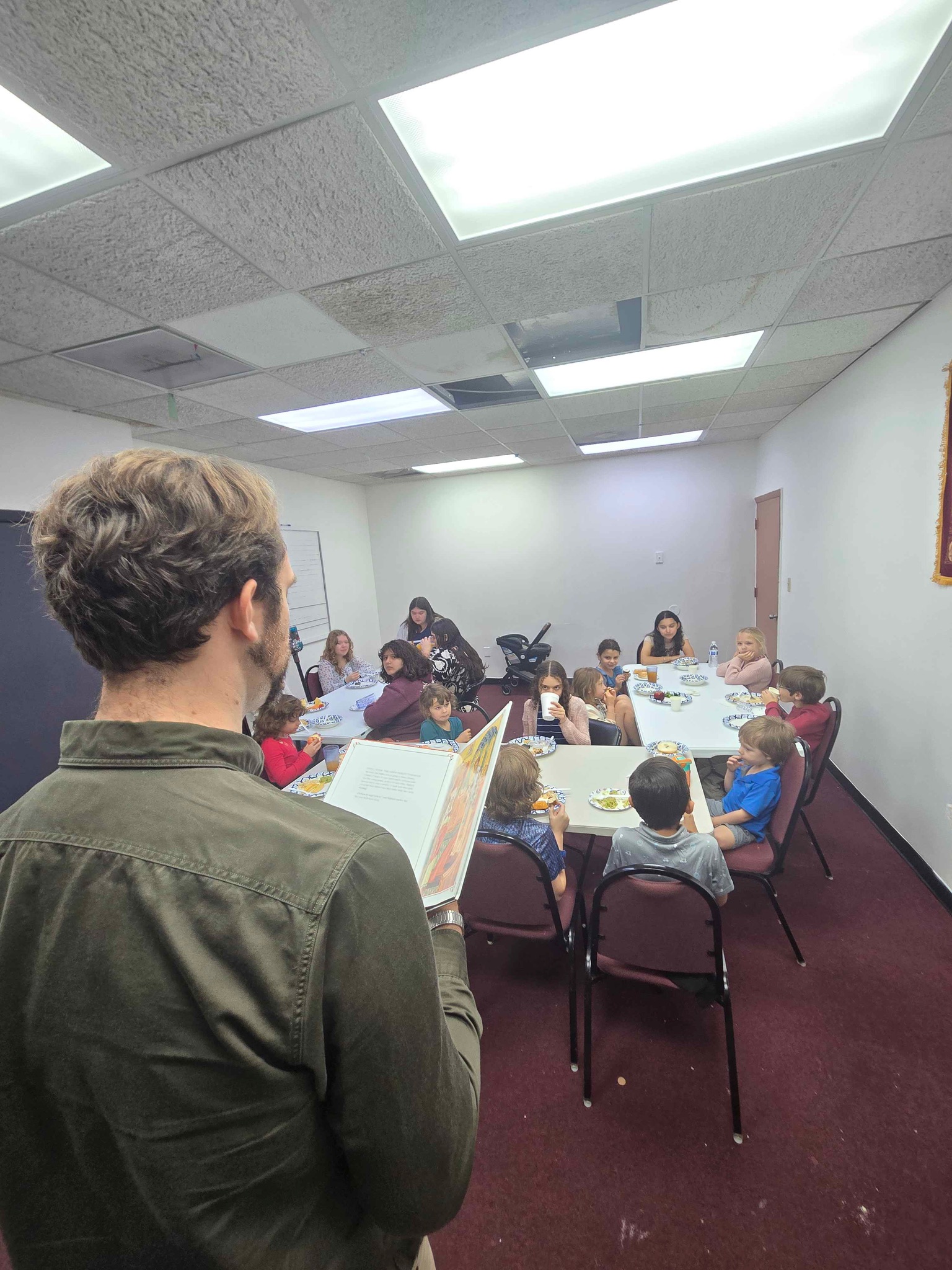

Because classroom space is shared with other parish activities, families are asked to help children transition smoothly at the end of class.
How it Works
Classes begin shortly after the blessing of food at coffee hour and are divided into two age groups: younger children and older children. Each class is led by faithful members of our parish who have completed diocesan background checks and are entrusted with the spiritual formation of our children.
Our current curriculum, Growing Through Scripture, follows the weekly Gospel readings of the Church year. Each week, the children:
- Revisit the Gospel reading proclaimed in the Liturgy
- Explore its themes in age-appropriate ways
- Learn how to navigate the Bible
- Discuss how the Gospel shapes life in the Church and at home
Students receive a full-color weekly guide with readings and activities, which they are encouraged to take home and keep. Over time, these lessons form a devotional “scrapbook” of their journey through the Church year.
Expectations
We aim for a healthy balance between order and energy. Children are learning — not performing. We expect:
- Respectful participation
- A willingness to listen and engage
- Parents to reinforce positive behavior at home and in class
Wiggles and whispers are not failures. Growth happens gradually, and we are committed to walking with families in that process.

Orthodox youth formed in faith and fellowship
Camp St. Christopher
Many of our parish families participate in Camp St. Christopher, a pan-Orthodox summer and winter camp serving youth from across Florida and beyond.
Camp St. Christopher is held each summer at a campground north of Orlando in the Ocala National Forest and gathers children ages 8–18 for a week of prayer, fellowship, outdoor activities, and Orthodox formation. The camp operates with the blessing of our bishop and welcomes youth from multiple Orthodox jurisdictions.
Each day at camp includes:
- Morning and evening prayers
- The Divine Liturgy served during the week
- Themed teaching rooted in Scripture and the lives of the saints
- Small group discussion
- Outdoor recreation, crafts, and games
The aim of camp is not simply recreation, but formation — helping young people deepen their love for Christ and His Church while building friendships rooted in faith.
Many of our children attend together, and carpooling is often arranged among families.
If you would like more information about upcoming summer or winter sessions, please visit the camp’s website or contact us.
A Living Church
Parish life with children requires patience, humility, and shared commitment. We do not shame parents or children. We do not expect silence at all costs. We do expect consistent effort, growth, and mutual respect.
Reverence is formed week by week, year by year. A church without children is quiet — and dying. A church with children is sometimes noisy — and very much alive.
Thank you for helping us raise our children in the worshipping life of the Church.