
How to Become Orthodox
If You Are Exploring Orthodoxy…
Many who find this page are drawn by the depth and stability of ancient Christian worship. Some are searching for a Church that has remained rooted in apostolic faith and sacramental life. Others feel unsettled by the fragmentation or constant reinvention they have experienced elsewhere. Some simply want a form of Christianity that takes formation, repentance, and prayer seriously.
Wherever you are beginning, you are not alone.
Exploring the Orthodox Church in Orlando does not require a sudden decision. It begins by worshiping, listening, and learning patiently within the life of the Church.
Visit and Worship
The first step is to worship.
Attend Divine Liturgy on Sunday. Come to Vespers as well. The rhythm of Orthodox life is shaped by both — the Sunday Eucharist and the evening prayer of the Church.
Orthodoxy is not learned primarily from explanation, but from participation. Before decisions are made, time is given to stand in prayer, to listen, and to become familiar with the life of the parish.
Conversion begins not with forms or formalities, but with worship.
Saturdays at 6:00 PM
“And there was evening and there was morning, the first day.”
Sundays at 9:30 AM
Each Sunday, the Church is gathered by God to proclaim the Word, offer thanksgiving, and receive the Body and Blood of Christ.
10:00 AM
During major seasons like Great Lent and Holy Week, additional services are added beyond the regular weekly schedule. See our calendar for more.

Inquirer Period
As you begin attending regularly, you may enter an informal period of inquiry.
This is a time for reading, asking questions, and meeting with the priest. It is also a time to speak with Orthodox Christians in the parish — to see how life in the Church has shaped them and drawn them more deeply into the fullness of Christ.
There is no fixed timetable. Some remain in this stage for months. The purpose is not speed, but clarity and discernment.
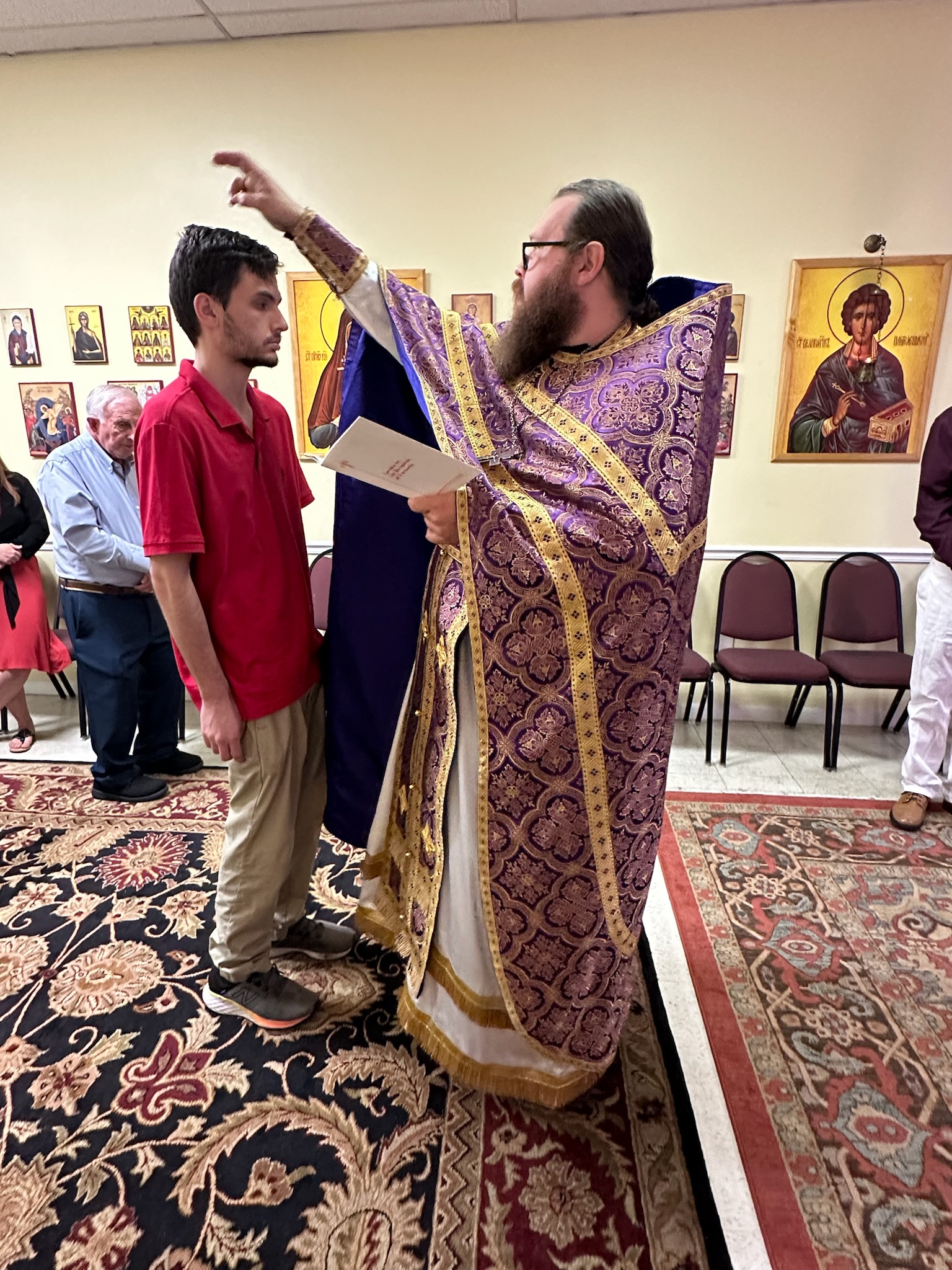
Catechumenate
When you are ready, you may be formally enrolled as a catechumen — someone preparing to enter the Orthodox Church.
Enrollment is not casual. It is a commitment to regular participation in the liturgical and instructional life of the parish.
The catechumenate includes:
• Faithful participation in Divine Liturgy and Vespers
• Structured catechism classes
• A developing rule of prayer
• Gradual integration into parish life
At St. John the Merciful, catechism classes meet on Saturday afternoons before Vespers and on Sundays after the dismissal of the catechumens during the Divine Liturgy.
Formal catechism is offered during the Nativity Fast (November 15–December 25) and during Great Lent. During the rest of the year, we gather for other instructional topics and continued formation.
The goal is not merely to understand Orthodox teaching, but to begin living it.
Reception into the Church
Before you are enrolled as a catechumen, you will meet with the priest to discuss your prior Christian background and how you will be received into the Church.
Reception in the Orthodox Church in America occurs in one of two ways:
• Holy Baptism, for those who have not previously received a baptism recognized by the Orthodox Church
• Holy Chrismation, for those whose prior baptism is recognized and who are being received into full communion
This determination is made pastorally and carefully, in accordance with the practice of the Orthodox Church in America.
Reception takes place within the Divine Liturgy, surrounded by the prayers of the parish. It is not a private act, but an entrance into the sacramental life of the Church.

What You Will Learn
Catechism in the Orthodox Church is not simply a course of study. It is an immersion into the life of the Church — her worship, her doctrine, her history, and her spiritual discipline.
During this period of formation, you will be instructed in:
• The Holy Trinity — Father, Son, and Holy Spirit
• The Incarnation of Christ and His saving work
• The Scriptures as received and interpreted within the Church
• The history of the early Church and the Ecumenical Councils
• The sacraments, especially Baptism, Chrismation, and the Eucharist
• The structure and meaning of the Divine Liturgy and the daily services
• The Church calendar — feasts, fasts, and the rhythm of the liturgical year
• Prayer, repentance, and the development of a personal rule of prayer
• Orthodox moral teaching and the transformation of daily life
At St. John the Merciful, formal catechism follows the rhythm of the Church’s fasting seasons, particularly the Nativity Fast and Great Lent, so that instruction unfolds within the living liturgical life of the parish.
Instruction takes place in conversation with Scripture, the Fathers, and the worship of the Church.
The aim is not merely to master concepts. It is to begin acquiring an Orthodox mind and heart — to grow into the fullness of life in Christ.
Frequently Asked Questions
Do I need to leave my current church immediately?
No.
If you are exploring Orthodoxy, begin by worshiping with us regularly while continuing to pray and discern carefully. As an inquirer, there are no formal expectations placed upon you.
When you are enrolled as a catechumen, however, you are committing to regular participation in the Sunday services and the life of the parish. During this period, catechumens do not receive the sacraments as they prepare to enter into full sacramental union. This is not a rejection of your prior Christian life, but a reflection of the Church’s understanding of sacramental unity.
Major decisions should be made with clarity and peace, not haste.
How long does catechism take?
There is no fixed timeline.
For many, the catechumenate lasts several months to a year. Sometimes it takes longer. Reception normally occurs when the catechumen, their sponsor, and the priest all agree that the person is ready.
Regular attendance at services and catechism classes is essential. If participation is inconsistent, preparation will naturally take longer. The goal is steady formation, not speed.
What if I was already baptized?
Before you are enrolled as a catechumen, you will meet with the priest to discuss your prior Christian background.
Reception into the Orthodox Church in America takes place either through Holy Baptism or through Holy Chrismation, depending on how your prior baptism is understood within Orthodox practice. This determination is made carefully and pastorally, as directed by our bishop, who is entrusted with this responsibility.
What about my spouse or children?
Each situation is approached with patience and care.
If you are married, we encourage open and honest conversation within your family. Spouses are never pressured. If your spouse is hesitant or opposed to your desire to become Orthodox, it is often wiser to allow a longer catechumenate than to create strain within your marriage.
Children are received according to their age and circumstances, and we walk with families carefully through that process.
What if I’m not sure yet?
That is perfectly normal.
Continue attending Divine Liturgy and Vespers. Sit in on the classes. Ask questions. Take your time.
We are not in a hurry. The Orthodox Church has been here from the beginning, and we are not going anywhere.
Orthodoxy is not entered impulsively. It is embraced gradually, through prayer and experience.